
How the Right Inventory Keeps Industrial Robots Running
In today’s manufacturing environment, every minute of downtime matters. Whether your facility relies on one robot or an entire automated production line, a single failed component can bring production to a standstill. That’s why effective spare parts management is one of the most overlooked—but most valuable—investments a manufacturer can make.
At 4C Robotics & Repair, LLC, we’ve seen firsthand how proper spare parts planning can mean the difference between a repair that takes hours and one that takes weeks.
Why Spare Parts Matter
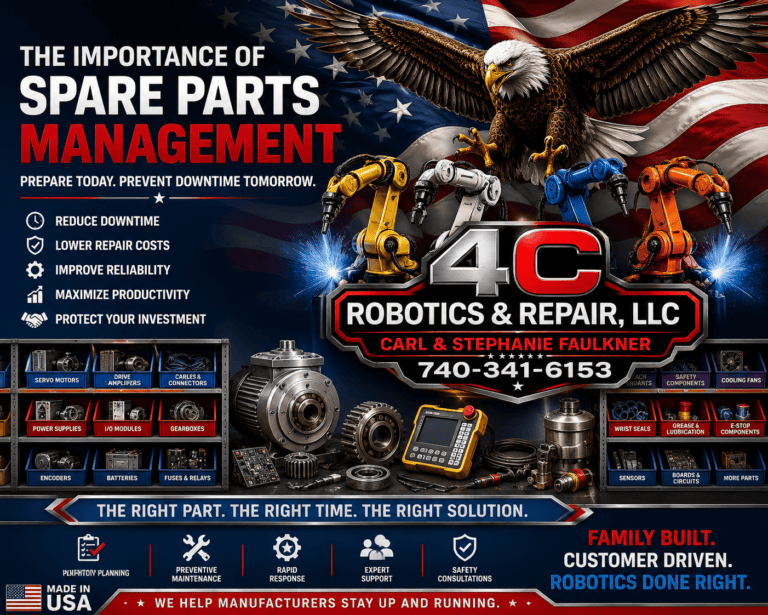
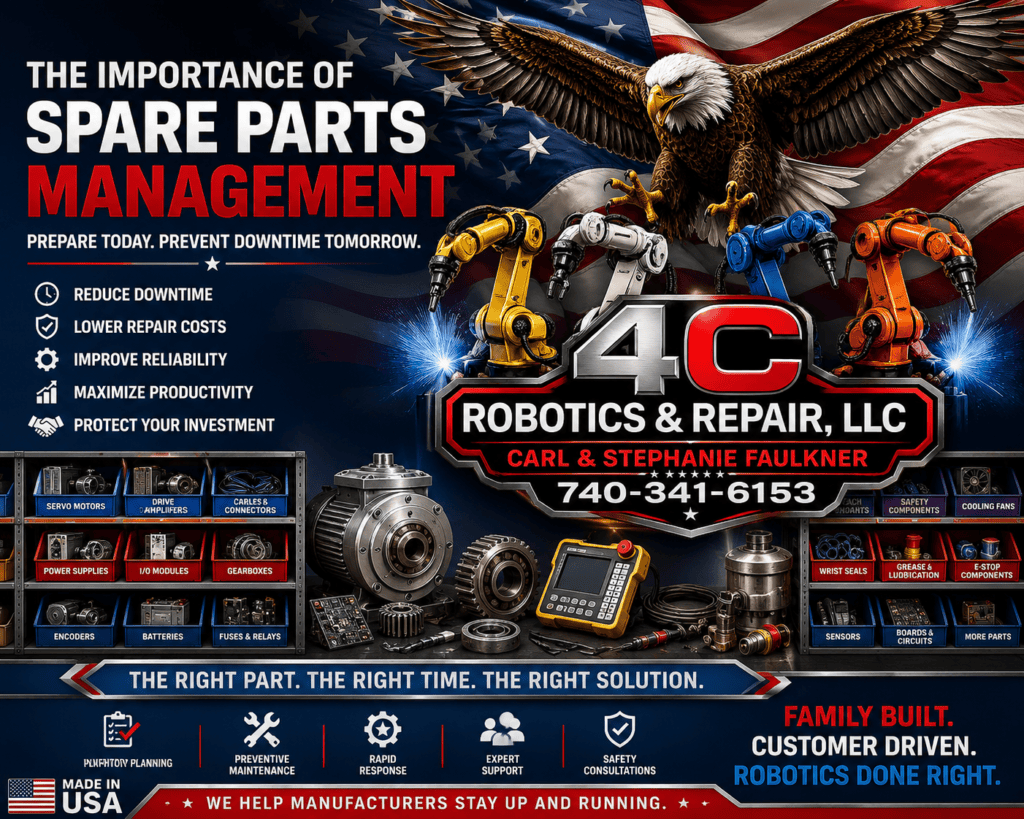
Industrial robots are incredibly reliable, but like any piece of equipment, components eventually wear out. Gearboxes, servo motors, encoders, teach pendants, cables, batteries, reducers, power supplies, and electronic boards all have finite service lives.
When these parts fail unexpectedly and replacements aren’t readily available, production often comes to a complete stop while companies search for replacement components.
The result?
- Lost production
- Missed customer deadlines
- Overtime labor
- Expedited shipping costs
- Increased stress throughout the organization
Many of these situations can be prevented with a well-managed spare parts program.
The Hidden Cost of Downtime
The cost of an industrial robot sitting idle extends far beyond the repair bill.
Downtime can affect:
- Production schedules
- Customer deliveries
- Employee productivity
- Equipment utilization
- Profitability
- Company reputation
For manufacturers running multiple shifts, even a few hours of unexpected downtime can cost thousands—or even tens of thousands—of dollars.
Having the right spare part on the shelf often turns a major emergency into a routine maintenance task.
Which Spare Parts Should You Stock?
Not every component needs to be kept in inventory. The key is identifying critical components that could significantly impact production if they fail.
Typical critical robot spare parts include:
- Robot controller batteries
- Servo amplifiers
- Servo motors
- Teach pendants
- Robot cables
- Encoders
- Gearboxes and reducers
- I/O modules
- Safety relays
- Power supplies
- Cooling fans
- Emergency stop components
- Fuses and circuit protection devices
- Robot wrist seals
- Grease and lubrication supplies
The specific inventory should be based on:
- Robot age
- Manufacturer support
- Lead times
- Failure history
- Production criticality
- Number of identical robots in service
Don’t Wait Until Parts Become Obsolete
One of the biggest challenges manufacturers face is component obsolescence.
As robot models age, manufacturers eventually discontinue replacement parts. Waiting until a component fails can leave companies searching secondary markets or rebuilding damaged components while production remains down.
Planning ahead allows businesses to:
- Purchase parts before they become obsolete
- Budget replacement costs
- Avoid inflated emergency pricing
- Extend the useful life of robotic systems
Organize Your Inventory
Simply owning spare parts isn’t enough.
A successful spare parts program should include:
- Clearly labeled inventory locations
- Part numbers
- Compatible robot models
- Quantity on hand
- Minimum inventory levels
- Purchase history
- Supplier information
- Inspection schedules for shelf-life items
Digital inventory tracking makes locating critical components fast during emergency repairs.
Preventive Maintenance and Spare Parts Go Together
Preventive maintenance often identifies components that are nearing failure before they cause unplanned downtime.
During scheduled inspections, technicians can monitor:
- Gearbox wear
- Servo temperatures
- Cable condition
- Grease quality
- Battery voltage
- Mechanical backlash
- Encoder health
Knowing these conditions allows companies to order replacement parts before an emergency occurs.
How 4C Robotics & Repair Can Help
At 4C Robotics & Repair, we help customers develop practical spare parts strategies based on their operations—not generic recommendations.
Our services include:
- Robot spare parts evaluations
- Critical spare parts recommendations
- Preventive maintenance inspections
- Robot repairs
- Robot refurbishments
- System troubleshooting
- Robot health assessments
- Inventory planning assistance
- Safety consultations
- Emergency robotic support
Our goal is simple: help customers reduce downtime, improve reliability, and maximize the life of their automation investment.
Invest Today—Save Tomorrow
The best time to prepare for a robot failure is before it happens.
An organized spare parts program reduces downtime, lowers repair costs, improves maintenance efficiency, and gives your team confidence when unexpected problems arise.
When combined with routine preventive maintenance and experienced technical support, spare parts management becomes one of the smartest investments a manufacturer can make.
Partner with 4C Robotics & Repair
Whether you’re building your first spare parts inventory or improving an existing maintenance program, 4C Robotics & Repair, LLC is ready to help.
Our mission is simple:
“To provide excellent customer service to all customers, no matter the time of day or need. In all things, do what is right, even if what’s right is difficult, in an effort to ensure the customer is honored to the highest standard.”
That commitment drives everything we do—from emergency robot repairs to preventive maintenance planning and spare parts management.
Contact 4C Robotics & Repair, LLC
Carl Faulkner – Owner & Operator
📞 740-341-6153
📧 cf@4croboticrepair.com
Stephanie Faulkner – Owner & Accounting
📞 567-231-6153
📧 4croboticsandrepair@gmail.com
