Working Smarter Together with Collaborative Robotics
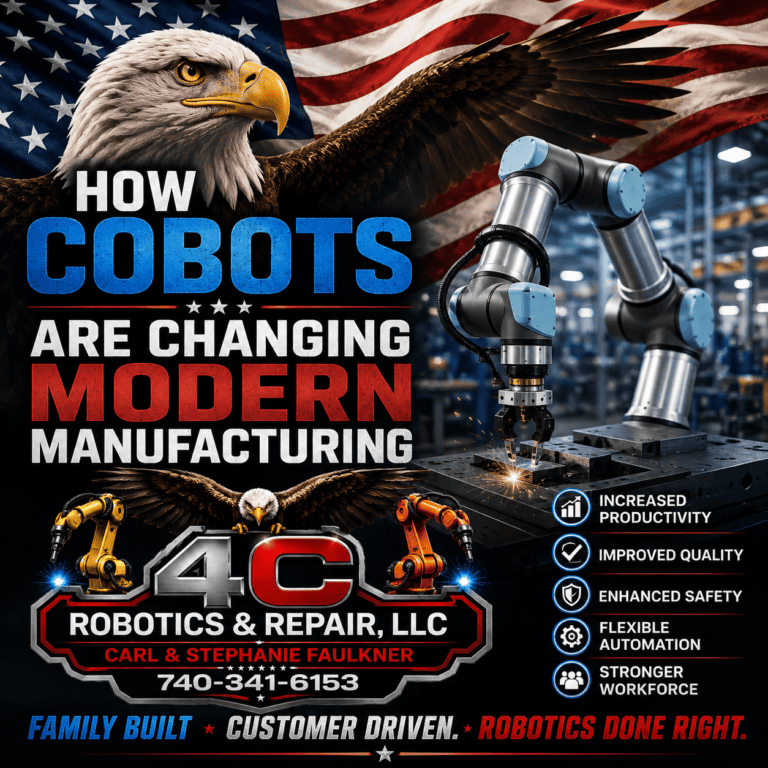
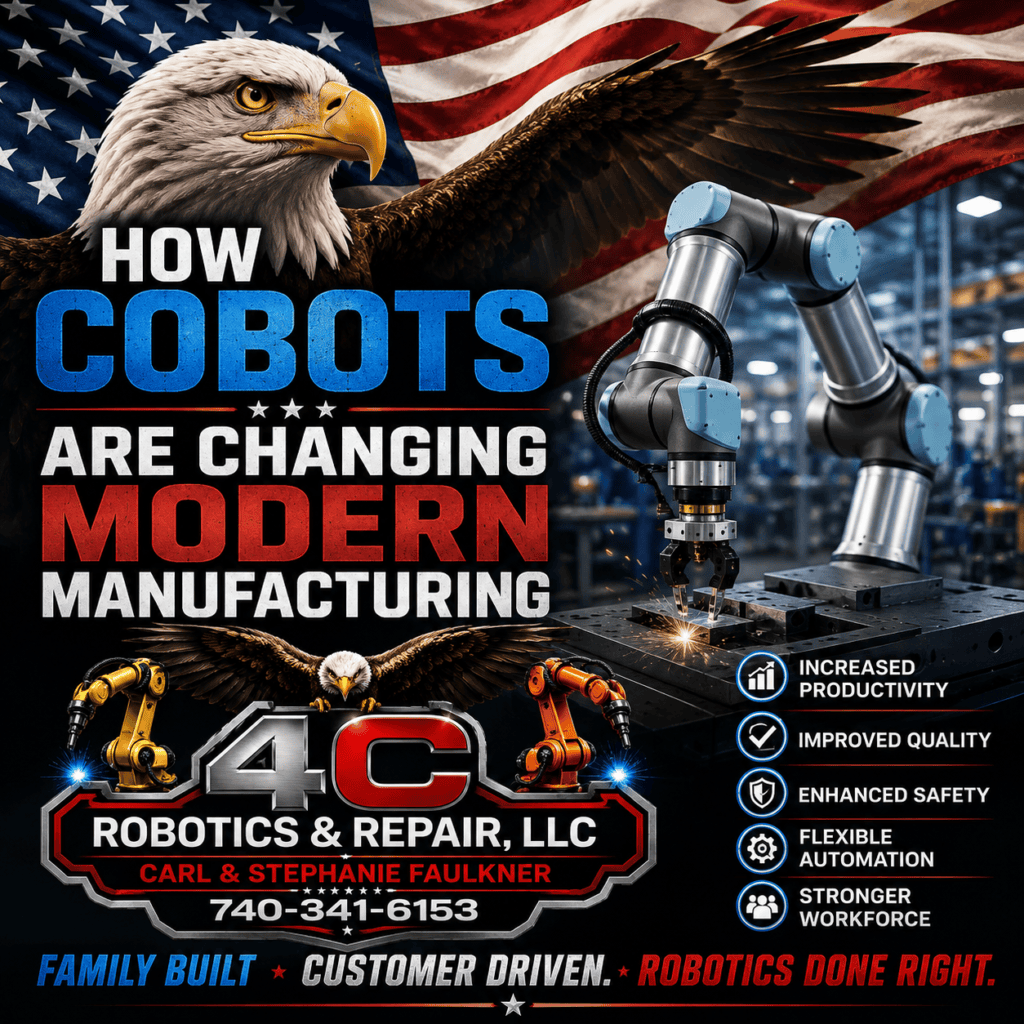
Modern manufacturing continues to evolve, and one of the biggest innovations transforming today’s factories is the rise of collaborative robots, better known as cobots. Unlike traditional industrial robots that often require large safety cages and dedicated work cells, cobots are designed to safely work alongside people, helping manufacturers increase productivity, improve quality, and solve workforce challenges.
At 4C Robotics & Repair, we understand that every manufacturing operation is different. Whether you’re looking to automate repetitive tasks or improve efficiency without replacing your workforce, cobots can provide a practical and cost-effective solution.
What Is a Collaborative Robot?
A collaborative robot is an industrial robot designed with advanced sensors, force monitoring, and safety features that allow it to work in close proximity to human operators. While traditional robots excel in high-speed, high-volume applications, cobots are ideal for flexible manufacturing environments where people and automation work together.
Cobots can be deployed for tasks such as:
- Machine tending
- Welding
- Assembly
- Material handling
- Pick-and-place operations
- Packaging
- Inspection and quality control
- Palletizing
Their flexibility makes them especially valuable for small and mid-sized manufacturers looking to automate without making massive capital investments.
Benefits of Cobots in Manufacturing
Increased Productivity
Cobots can perform repetitive tasks continuously with consistent cycle times, allowing employees to focus on higher-value responsibilities that require critical thinking and problem-solving.
Improved Quality
Human error is inevitable, especially during repetitive work. Cobots perform programmed tasks the same way every cycle, improving consistency and reducing scrap or rework.
Enhanced Employee Safety
Many manufacturing jobs involve repetitive motion, awkward lifting, or hazardous environments. Cobots can take over these physically demanding tasks, reducing employee fatigue and lowering the risk of workplace injuries.
Faster Return on Investment
Compared to traditional robotic automation, cobots often require less infrastructure, simpler programming, and lower installation costs, allowing companies to realize a faster return on investment.
Flexible Manufacturing
Product lines and customer demands constantly change. Cobots can often be reprogrammed and redeployed much faster than traditional robotic systems, giving manufacturers greater flexibility.
Cobots Don’t Replace Employees—They Empower Them
One of the biggest misconceptions surrounding automation is that robots replace people.
In reality, successful manufacturers use cobots to assist employees—not replace them.
Cobots handle repetitive, physically demanding, or ergonomically challenging tasks while skilled workers focus on setup, troubleshooting, quality assurance, maintenance, programming, and continuous improvement.
The result is a safer workplace, higher productivity, and a stronger manufacturing team.
Applications Across Industries
Collaborative robots are now being used in nearly every manufacturing sector, including:
- Automotive
- Plastics
- Food Processing
- Consumer Products
- Aerospace
- Metal Fabrication
- Packaging
- Medical Device Manufacturing
- General Industrial Manufacturing
Their versatility allows businesses of all sizes to benefit from automation.
Proper Programming and Maintenance Matter
Like any piece of manufacturing equipment, cobots require proper programming, preventive maintenance, and routine inspections to perform reliably.
Even the most advanced collaborative robot can experience:
- Calibration issues
- Programming errors
- Wear on mechanical components
- End-of-arm tooling failures
- Communication faults
- Electrical or servo issues
Routine maintenance helps prevent unexpected downtime while maximizing equipment life and production efficiency.
Why Choose 4C Robotics & Repair?
At 4C Robotics & Repair, we help manufacturers maximize the value of their automation investments by providing dependable robotic support and technical expertise.
Our services include:
- Collaborative robot programming
- Troubleshooting and diagnostics
- Preventive maintenance
- Robot repair and refurbishment
- Emergency robot service
- Robot calibration
- Automation consulting
- Safety consultations for robotic work cells
- Training and technical support
Whether your facility operates collaborative robots, traditional industrial robots, or both, our experienced team is ready to help keep your production running.
The Future Is Collaborative
The future of manufacturing isn’t about choosing between people or robots—it’s about combining the strengths of both.
Collaborative robots help manufacturers improve productivity, address skilled labor shortages, increase workplace safety, and remain competitive in an ever-changing marketplace.
As automation technology continues to advance, companies that embrace collaborative robotics today will be better positioned for tomorrow’s manufacturing challenges.
At 4C Robotics & Repair, we’re proud to help manufacturers implement, maintain, and support the automation solutions that keep production moving.
Because at the end of the day, it’s about more than repairing robots—it’s about building long-term partnerships and helping our customers succeed.
Contact 4C Robotics & Repair
4C Robotics & Repair, LLC
Family Built. Customer Driven. Robotics Done Right.
Carl Faulkner – Owner & Operator
📞 740-341-6153
📧 cf@4croboticrepair.com
Stephanie Faulkner – Co-Owner & Accounting
📞 567-231-6153
📧 4croboticsandrepair@gmail.com
