
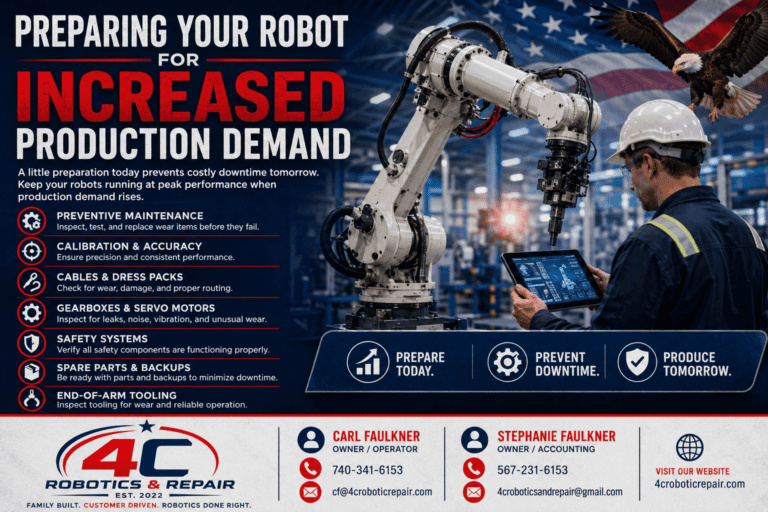
Why Preventive Preparation Pays Off
As production schedules ramp up, industrial robots are expected to work harder, faster, and longer than ever before. Whether you’re preparing for seasonal demand, launching a new product, or fulfilling larger customer orders, your robots must be ready to perform reliably.
At 4C Robotics & Repair, we’ve seen firsthand how a little preparation before production increases can prevent costly downtime, extend equipment life, and improve overall efficiency. The companies that invest in preventive maintenance before production spikes are often the ones that avoid emergency repairs when demand is at its highest.
Why Production Increases Put More Stress on Robots
Industrial robots are designed for durability, but increased production means:
- More operating hours
- Higher cycle counts
- Increased wear on mechanical components
- Greater heat generation
- More strain on servo motors and gearboxes
- Faster wear of cables, hoses, and dress packs
Without proper preparation, small issues can quickly become major failures during your busiest production periods.
Key Areas to Inspect Before Production Ramps Up
1. Perform a Complete Preventive Maintenance Inspection
Don’t wait until something fails. A scheduled preventive maintenance inspection helps identify problems before they affect production.
Inspect:
- Servo motors
- Gearboxes
- Reducers
- Bearings
- Cable routing
- Electrical connections
- Safety devices
- End-of-arm tooling (EOAT)
Preventive maintenance is always less expensive than emergency downtime.
2. Check Robot Calibration
Robot accuracy is critical when production volumes increase.
Verify:
- TCP (Tool Center Point)
- Frame calibration
- Axis mastering
- Positional repeatability
Even minor calibration issues can lead to rejected parts, scrap, or inconsistent weld quality when thousands of cycles are involved.
3. Inspect Robot Cables and Dress Packs
Production increases mean more robot movement.
Look for:
- Cracked cable jackets
- Pinched cables
- Excessive twisting
- Broken strain reliefs
- Loose connectors
Replacing a worn cable during scheduled downtime is much easier than replacing it after it fails during production.
4. Examine Gearboxes and Servo Motors
These components absorb tremendous stress during continuous operation.
Watch for:
- Oil leaks
- Excessive backlash
- Unusual vibration
- Increased operating temperatures
- Abnormal noise
Early detection can prevent catastrophic mechanical failures.
5. Verify Safety Systems
Increased production should never compromise employee safety.
Confirm proper operation of:
- Emergency Stops
- Light Curtains
- Safety Scanners
- Interlock Gates
- Area Scanners
- Safety PLCs
A safe production environment is a productive production environment.
6. Review Spare Parts Inventory
Waiting days for a replacement part can shut down production.
Consider stocking:
- Servo amplifiers
- Teach pendants
- Encoder batteries
- Robot batteries
- Dress packs
- Gearbox seals
- Fans
- Fuses
- Relays
Having critical spare parts available can significantly reduce downtime.
7. Update Robot Software and Backups
Before production begins:
- Create current controller backups
- Save robot programs
- Verify software revisions
- Archive configuration files
A complete backup can dramatically reduce recovery time if unexpected issues occur.
8. Inspect End-of-Arm Tooling
The robot may be functioning perfectly while the tooling causes production problems.
Inspect:
- Grippers
- Weld guns
- Vacuum systems
- Sensors
- Fasteners
- Pneumatic lines
- Tool alignment
Reliable tooling ensures consistent product quality.
Don’t Ignore the Warning Signs
If you notice any of the following before production increases, address them immediately:
- Intermittent robot faults
- Servo alarms
- Position drift
- Slow cycle times
- Oil leaks
- Excessive heat
- Abnormal vibration
- Strange noises
- Loose components
Small warning signs today often become expensive breakdowns tomorrow.
Why Preventive Maintenance Saves Money
Unexpected robot downtime can cost manufacturers thousands of dollars per hour when considering:
- Lost production
- Missed deliveries
- Overtime labor
- Emergency service calls
- Replacement parts
- Product scrap
- Customer dissatisfaction
Preventive maintenance is an investment that protects productivity, profitability, and customer confidence.
Partner with 4C Robotics & Repair
At 4C Robotics & Repair, we help manufacturers prepare their robotic systems for increased production demands through comprehensive inspections, preventive maintenance, diagnostics, repairs, refurbishments, and emergency service.
Whether your facility operates FANUC, ABB, KUKA, Yaskawa/Motoman, or collaborative robots (cobots), our experienced team is committed to keeping your automation running at peak performance.
When production demand rises, you need a robotics partner you can trust to keep your equipment operating safely and efficiently.
Contact 4C Robotics & Repair
Carl Faulkner – Owner/Operator
📞 740-341-6153
📧 cf@4croboticrepair.com
Stephanie Faulkner – Owner/Accounting
📞 567-231-6153
📧 4croboticsandrepair@gmail.com
🌐 Website: https://4croboticrepair.com
Family Built. Customer Driven. Robotics Done Right.
No matter how demanding your production schedule becomes, 4C Robotics & Repair is ready to help keep your robots operating at their very best.
