By 4C Robotics & Repair
In today’s manufacturing environment, industrial robots are expected to perform with exceptional precision, consistency, and reliability. Whether welding, material handling, machine tending, palletizing, or assembly operations, even the slightest deviation in robot positioning can result in costly defects, downtime, and lost productivity.
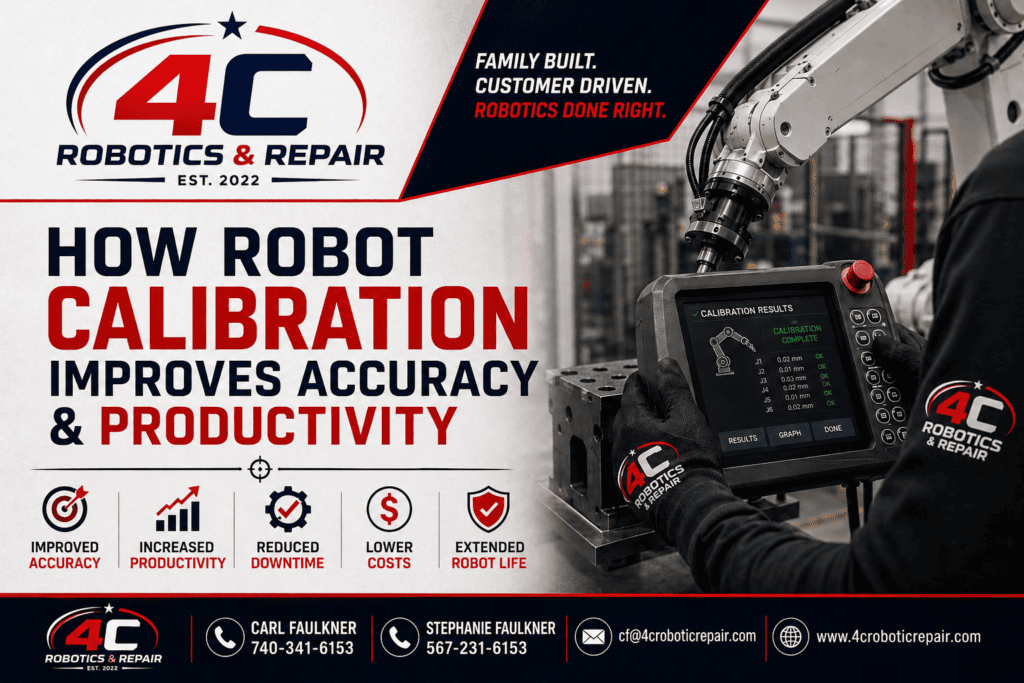
One of the most important yet often overlooked aspects of robotic maintenance is robot calibration. Proper calibration ensures your robot is operating exactly as intended, helping manufacturers maximize production output while maintaining quality standards.
At 4C Robotics & Repair, we understand that keeping robots performing at their best is critical to your operation’s success. Regular calibration is a key component of that success.
What Is Robot Calibration?
Robot calibration is the process of verifying and adjusting a robot’s positional accuracy to ensure it moves precisely to programmed locations.
Over time, factors such as:
- Normal wear and tear
- Gearbox wear
- Collision events
- Mechanical adjustments
- Joint component replacement
- Encoder replacement
- Heavy production cycles
can cause a robot’s accuracy to drift from its original specifications.
Calibration helps identify and correct these deviations before they impact production.
Why Accuracy Matters
Many manufacturing processes rely on tolerances measured in millimeters—or even fractions of a millimeter.
When a robot loses accuracy, manufacturers may experience:
- Poor weld quality
- Misaligned parts
- Assembly defects
- Increased scrap rates
- Fixture damage
- Additional rework
- Production delays
A properly calibrated robot consistently reaches the correct location every cycle, reducing variation and improving product quality.
Increased Productivity Through Calibration
Accuracy and productivity go hand-in-hand.
When robots are operating outside acceptable tolerances, operators and maintenance personnel often spend valuable time:
- Adjusting programs
- Touching up welds
- Reworking defective parts
- Troubleshooting process issues
- Making fixture adjustments
These temporary fixes can mask the real problem—robot positioning errors.
Proper calibration helps eliminate these inefficiencies by restoring the robot’s intended performance, allowing production to run smoothly and consistently.
Benefits include:
✔ Reduced downtime
✔ Faster cycle times
✔ Improved first-pass quality
✔ Less rework
✔ Lower scrap costs
✔ Increased equipment reliability
Common Signs Your Robot May Need Calibration
If your robot is showing any of the following symptoms, calibration should be considered:
Inconsistent Weld Locations
Welds appear slightly different from part to part despite using the same program.
Parts No Longer Fit Correctly
Assembly components require manual adjustments or force to fit.
Increased Scrap Rates
Product quality begins declining without obvious process changes.
Frequent Program Touch-Ups
Operators repeatedly modify robot positions to compensate for accuracy issues.
Collision or Impact Events
Even minor collisions can affect robot positioning and should be evaluated immediately.
Major Component Replacement
Replacement of motors, gearboxes, encoders, or mechanical components often requires recalibration.
Calibration Helps Extend Robot Life
Many manufacturers focus solely on production output and overlook the long-term benefits of calibration.
When a robot consistently operates within its designed parameters:
- Mechanical stress is reduced
- Components experience less wear
- Unexpected failures decrease
- Preventative maintenance becomes more effective
Calibration allows maintenance teams to identify potential issues before they become costly breakdowns.
Calibration as Part of Preventative Maintenance
Robot calibration should not be viewed as a one-time event. Instead, it should be incorporated into a comprehensive preventative maintenance strategy.
Regular calibration checks can help:
- Maintain OEM accuracy standards
- Detect mechanical wear early
- Verify repairs were completed correctly
- Improve overall equipment effectiveness (OEE)
- Reduce unplanned downtime
A proactive approach is always less expensive than reacting to production failures.
Partner with 4C Robotics & Repair
At 4C Robotics & Repair, we provide professional robotic maintenance, repair, refurbishment, and support services designed to keep your automation systems operating at peak performance.
Our experienced team can assist with:
- Robot Calibration Verification
- Preventative Maintenance Programs
- Robot Repair Services
- Robot Refurbishment
- Emergency Breakdown Support
- Safety Consultations
- Automation Troubleshooting
With more than 14 years of robotics experience, we understand the importance of accuracy, reliability, and productivity in today’s manufacturing environment.
Contact 4C Robotics & Repair
4C Robotics & Repair, LLC
Family Built. Customer Driven. Robotics Done Right.
📞 Carl Faulkner: 740-341-6153
📧 Email: cf@4croboticrepair.com
📞 Stephanie Faulkner: 567-231-6153
📧 Email: 4croboticsandrepair@gmail.com
Serving manufacturers with professional robotic repair, refurbishment, preventative maintenance, calibration support, and safety consultation services.
Contact 4C Robotics & Repair today to learn how proper robot calibration can improve your accuracy, productivity, and bottom line.
