
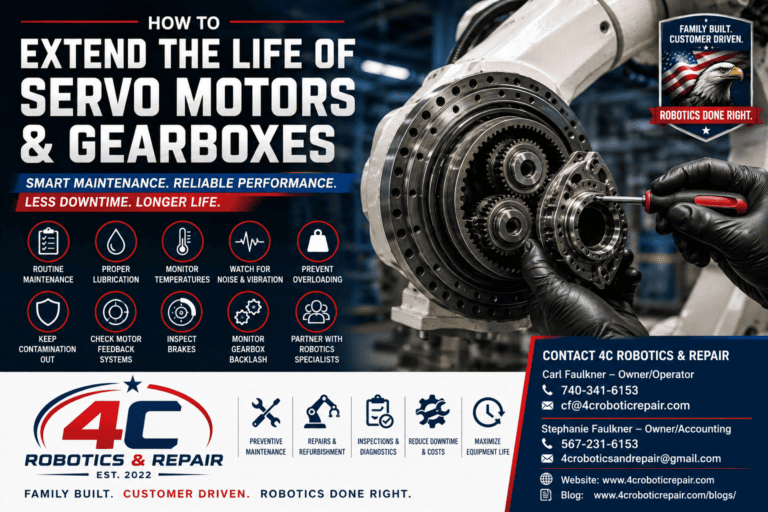
Protect Your Investment with Preventive Maintenance and Smart Operating Practices
Industrial robots are designed to deliver years—even decades—of reliable service. However, two of the most critical components that determine a robot’s lifespan are its servo motors and gearboxes. When these components begin to wear, manufacturers often experience reduced accuracy, unexpected downtime, costly repairs, and lost production.
At 4C Robotics & Repair, we’ve helped manufacturers extend the life of their robotic systems through preventive maintenance, inspections, and expert repair services. With the right maintenance strategy, you can significantly reduce failures and maximize your return on investment.
Why Servo Motors & Gearboxes Matter
Servo motors provide the precise movement that allows industrial robots to perform accurate, repeatable tasks. Gearboxes convert that motion into the torque required for lifting, welding, palletizing, material handling, and countless other manufacturing processes.
Because these components operate thousands—even millions—of times throughout their service life, they naturally experience wear. The key is identifying and addressing small issues before they become major failures.
1. Perform Routine Preventive Maintenance
Preventive maintenance is the single most effective way to extend component life.
A scheduled maintenance program should include:
- Visual inspections
- Bolt torque verification
- Cable and connector inspections
- Encoder and feedback system checks
- Lubrication inspections
- Robot mastering verification
- Brake inspections
- Gearbox oil or grease evaluations (where applicable)
Small problems caught early are far less expensive than emergency repairs.
2. Keep Robots Properly Lubricated
Many industrial robot gearboxes require specialized lubricants designed specifically for precision robotics.
Improper lubrication can cause:
- Excessive heat
- Premature bearing wear
- Increased backlash
- Gear damage
- Seal failures
Always use the manufacturer’s recommended lubricant and follow the appropriate service intervals.
3. Monitor Operating Temperatures
Heat is one of the biggest enemies of servo motors.
Excessive temperatures can damage:
- Bearings
- Windings
- Insulation
- Encoders
- Seals
Common causes include:
- Poor ventilation
- Overloaded robots
- Dirty cooling fans
- High ambient temperatures
- Continuous high-duty cycles
Thermal imaging inspections are an excellent way to identify developing problems before failure occurs.
4. Watch for Unusual Noise or Vibration
Robots should operate smoothly and consistently.
Warning signs include:
- Clicking
- Grinding
- Whining
- Excessive vibration
- Jerky movement
- Axis hesitation
These symptoms often indicate bearing wear, gearbox damage, brake issues, or motor deterioration.
Ignoring these early warning signs usually leads to much larger repairs later.
5. Prevent Overloading
Every industrial robot has payload and moment limitations.
Consistently exceeding those limits dramatically increases wear on:
- Servo motors
- Gearboxes
- Bearings
- Harmonic drives
- Reducers
Even small overloads over time can shorten the life of expensive components.
6. Keep Contamination Out
Dust, welding spatter, coolant, oil, and moisture are all enemies of precision robotics.
Inspect regularly for:
- Damaged seals
- Torn dress packs
- Cable wear
- Moisture intrusion
- Contaminated connectors
A clean robot is typically a healthier robot.
7. Check Motor Feedback Systems
Servo motors rely on encoders and feedback devices for accurate positioning.
Faulty feedback can cause:
- Position errors
- Repeatability issues
- Robot alarms
- Unexpected movement
- Production defects
Routine testing helps detect encoder issues before they affect production.
8. Inspect Brakes Before They Fail
Servo brakes often go unnoticed until they stop working.
Signs of brake wear include:
- Axis drifting
- Inconsistent holding
- Startup alarms
- Unusual stopping characteristics
Brake inspections should be part of every preventive maintenance program.
9. Monitor Gearbox Backlash
As gearboxes wear, backlash gradually increases.
Excessive backlash can lead to:
- Poor part quality
- Welding inaccuracies
- Pick-and-place errors
- Calibration problems
- Increased cycle times
Periodic inspections allow repairs before catastrophic gearbox failure occurs.
10. Partner with Robotics Specialists
Having experienced robotics professionals inspect your equipment regularly can identify issues that operators may never notice.
Professional services include:
- Preventive maintenance
- Mechanical inspections
- Servo diagnostics
- Gearbox evaluations
- Calibration verification
- Software updates
- Emergency repair services
- Refurbishment planning
Routine inspections often prevent thousands of dollars in unplanned downtime.
The 4C Robotics & Repair Difference
At 4C Robotics & Repair, we believe maintenance isn’t just about fixing equipment—it’s about building long-term partnerships with our customers. As a family-owned business, Carl and Stephanie Faulkner understand how important reliable production is to your operation.
Whether your facility uses FANUC, ABB, KUKA, Yaskawa/Motoman, or collaborative robots, our team is committed to helping you maximize uptime, extend equipment life, and reduce maintenance costs.
Our mission is simple:
Family Built. Customer Driven. Robotics Done Right.
Need Help Extending the Life of Your Robots?
Whether you’re looking for preventive maintenance, emergency repairs, refurbishment, inspections, or technical support, 4C Robotics & Repair is here to help.
Contact 4C Robotics & Repair
Carl Faulkner – Owner/Operator
📞 740-341-6153
📧 cf@4croboticrepair.com
Stephanie Faulkner – Owner/Accounting
📞 567-231-6153
📧 4croboticsandrepair@gmail.com
🌐 Website: https://4croboticrepair.com
📰 Blog: https://4croboticrepair.com/blogs/
When your robots perform at their best, your entire operation benefits. With proactive maintenance and expert support, you can keep your servo motors and gearboxes running smoothly for years to come. Let 4C Robotics & Repair help protect your investment and keep your production moving.
