
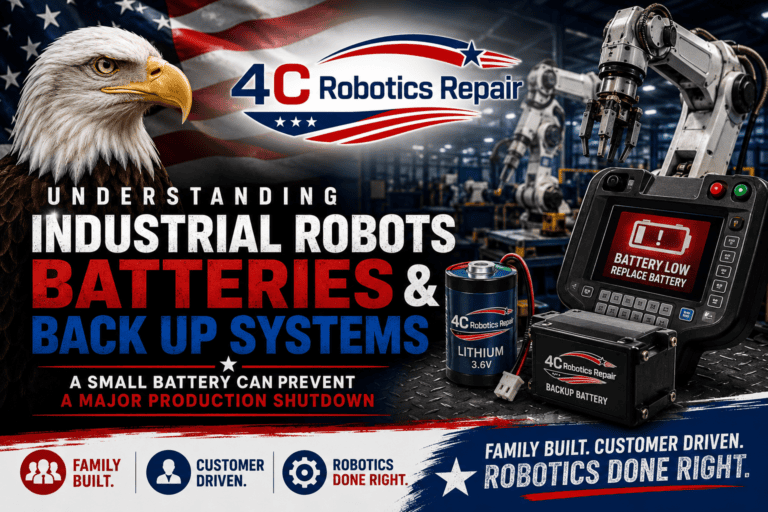
Why a Small Battery Can Prevent a Major Production Shutdown
Industrial robots are built for precision, reliability, and continuous operation—but even the most advanced robot depends on something surprisingly small to keep it running correctly: its backup batteries.
Many manufacturers don’t think about robot batteries until an unexpected failure occurs. Unfortunately, by that point the damage may already be done, resulting in lost programs, encoder faults, lengthy downtime, and costly repairs.
At 4C Robotics & Repair, we’ve seen firsthand how something as inexpensive as a battery replacement can save thousands of dollars in emergency service, lost production, and reprogramming.
What Do Robot Backup Batteries Actually Do?
Industrial robots use several battery systems to preserve critical information whenever power is removed from the controller or robot.
Depending on the robot manufacturer and model, backup batteries may maintain:
- Encoder position data
- Absolute position information
- System parameters
- Robot mastering data
- Program memory
- Controller configuration
- Calibration information
These batteries allow the robot to “remember” where it is, even after power has been shut off.
Without a healthy battery, the robot may lose this information and require additional service before production can resume.
Common Battery Types Found in Industrial Robots
Most industrial robots contain one or more of the following battery systems:
Encoder (Absolute Encoder) Batteries
These maintain the robot’s position data.
If these batteries fail:
- Absolute position may be lost
- Robot mastering may be required
- Production delays can occur
Controller Memory Batteries
These help preserve controller memory and important system settings.
Failure can result in:
- Lost system parameters
- Program loss
- Controller faults
- Additional recovery time
Servo Amplifier or Axis Batteries
Certain robot systems utilize additional batteries within servo amplifiers or other components to maintain specific data during power interruptions.
Signs Your Robot Battery May Need Replaced
Watch for warning signs such as:
- Low battery alarms
- Battery warning messages
- Absolute encoder alarms
- Mastering errors
- Unexpected position shifts
- Battery replacement reminders
- Robot requesting initialization after shutdown
Ignoring these warnings often turns a simple maintenance task into a much larger repair.
How Often Should Robot Batteries Be Replaced?
Although recommendations vary by manufacturer, a good preventive maintenance practice is:
- Every 12–24 months
- During scheduled preventive maintenance
- Before low battery alarms appear
- Whenever purchasing a used robot (unless battery history is verified)
Waiting until the battery actually fails greatly increases the risk of losing valuable system information.
Why Battery Replacement Isn’t Always “Just Changing a Battery”
One of the biggest misconceptions is that robot batteries can simply be swapped out like batteries in a flashlight.
Improper battery replacement can result in:
- Loss of encoder counts
- Robot needing to be remastered
- Lost calibration
- Production downtime
- Service calls that could have been avoided
Some robots require batteries to be replaced while the controller remains powered on, while others have different procedures depending on the manufacturer and model.
Following the correct procedure is critical.
The Importance of Preventive Maintenance
Battery replacement should always be part of a comprehensive preventive maintenance program.
Routine inspections should also include:
- Cable inspections
- Gearbox inspections
- Grease checks
- Cooling fan inspection
- Electrical connection verification
- Controller cleaning
- Backup verification
- Emergency stop testing
- Safety device inspections
Preventive maintenance helps maximize robot life while minimizing unexpected downtime.
Don’t Forget Your Robot Backups
Even with healthy batteries, every facility should maintain current backups of:
- Robot programs
- Controller parameters
- I/O configuration
- System variables
- Option files
- Calibration data (when applicable)
Having current backups dramatically reduces recovery time if a failure ever occurs.
Used Robots Need Immediate Attention
If you’ve recently purchased a used or refurbished robot, one of the first maintenance items should be replacing all backup batteries unless documented maintenance records confirm they were recently changed.
Many used robots sit in storage for months—or even years—before being installed.
Replacing batteries before startup helps prevent unnecessary surprises.
How 4C Robotics & Repair Can Help
At 4C Robotics & Repair, we provide preventive maintenance and battery replacement services for many of today’s leading industrial robot brands, including:
- FANUC
- ABB
- Yaskawa Motoman
- KUKA
Our experienced technicians help customers:
- Replace robot batteries correctly
- Perform preventive maintenance inspections
- Verify robot backups
- Restore systems after battery failures
- Troubleshoot encoder and mastering issues
- Keep production running with minimal downtime
Whether you operate one robot or an entire robotic production line, proactive maintenance can significantly reduce unexpected failures and costly downtime.
Final Thoughts
Industrial robot batteries may be one of the smallest components in your automation system, but they protect some of its most valuable information.
Replacing them on schedule—and maintaining current system backups—is one of the simplest, most cost-effective ways to avoid unnecessary downtime and expensive repairs.
Don’t wait for a low battery alarm to become a production emergency.
Let 4C Robotics & Repair help keep your robotic systems operating reliably, efficiently, and safely.
Contact 4C Robotics & Repair, LLC
Family Built. Customer Driven. Robotics Done Right.
Carl Faulkner – Owner & Operator
📞 740-341-6153
📧 cf@4croboticrepair.com
Stephanie Faulkner – Co-Owner & Accounting
📞 567-231-6153
📧 4croboticsandrepair@gmail.com
