Manufacturing has changed dramatically over the last several decades. What once relied entirely on manual labor is now increasingly powered by advanced automation systems and industrial robots. As technology continues to evolve, industrial robotics are becoming one of the most important investments a company can make to remain competitive, efficient, and prepared for the future.
At 4C Robotics & Repair, we believe industrial robotics are not just a trend — they are the future of modern manufacturing.
What Are Industrial Robots?
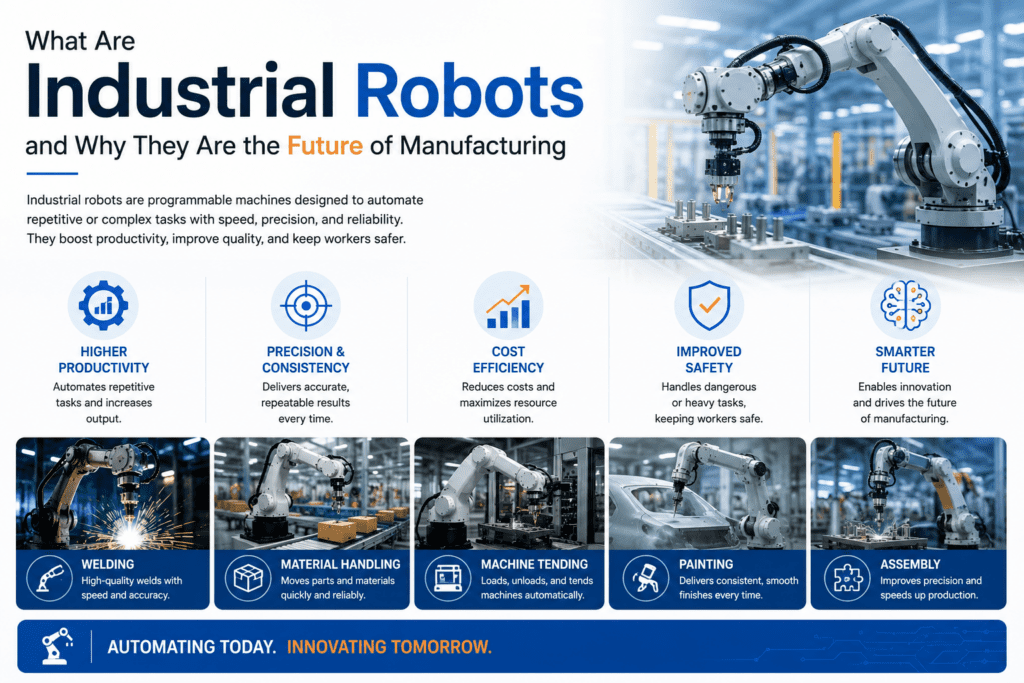
Industrial robots are programmable automated machines designed to perform manufacturing tasks with speed, precision, and repeatability. These robotic systems can operate continuously with minimal downtime while handling tasks that may be dangerous, repetitive, or physically demanding for human workers.
Most industrial robots are designed with multiple axes of movement, allowing them to perform complex motions similar to a human arm. Combined with advanced programming, sensors, and tooling, robots can complete highly accurate tasks repeatedly with consistent quality.
Industrial robots are commonly used in:
- Welding
- Material handling
- Machine tending
- Assembly operations
- Packaging
- Painting
- Inspection and quality control
- Palletizing
- Cutting and grinding
Leading robotic manufacturers include:
- FANUC
- ABB
- KUKA
- Yaskawa Motoman
These robotic systems are used across industries including automotive, heavy equipment manufacturing, food processing, aerospace, logistics, and metal fabrication.
Why Industrial Robots Are Growing Rapidly
Manufacturers today face several major challenges:
- Labor shortages
- Increased production demands
- Rising operational costs
- Safety concerns
- Quality consistency requirements
- Competitive global markets
Industrial robots help solve many of these issues by allowing companies to automate repetitive and demanding processes while improving overall operational efficiency.
Robotics are no longer limited to massive automotive factories. Today, automation is becoming more affordable and accessible for small and mid-sized manufacturers as well.
Benefits of Industrial Robots
1. Increased Productivity
Industrial robots can work continuously with minimal interruptions. Unlike manual processes, robots maintain consistent speeds and repeatability throughout production runs.
This allows manufacturers to:
- Increase throughput
- Reduce bottlenecks
- Improve scheduling consistency
- Meet customer demand faster
Many robotic systems can operate 24/7 with proper maintenance and support.
2. Improved Safety
Some manufacturing tasks expose workers to:
- Heavy lifting
- Repetitive strain
- Hot materials
- Welding fumes
- Sharp edges
- Dangerous machinery
Industrial robots can perform many of these hazardous operations, helping reduce workplace injuries and improving overall safety performance.
Automation allows employees to focus more on monitoring, programming, quality control, and skilled technical work rather than high-risk repetitive labor.
3. Better Quality and Consistency
One of the greatest advantages of robotics is repeatability. Robots can perform the same programmed movement thousands of times with extremely high precision.
This results in:
- Improved weld quality
- More consistent production
- Reduced scrap
- Lower rework costs
- Better customer satisfaction
Consistency is critical in industries where tight tolerances and repeatable results are required.
4. Reduced Long-Term Costs
Although automation requires an upfront investment, industrial robots often reduce long-term operational costs through:
- Lower scrap rates
- Reduced downtime
- Improved efficiency
- Increased production output
- Reduced labor dependency
Over time, many robotic systems pay for themselves through productivity gains and operational savings.
5. Workforce Support — Not Replacement
A common misconception is that robots replace workers entirely. In reality, most successful automation programs use robots to support employees, not eliminate them.
Robots are best suited for:
- Repetitive tasks
- Dangerous operations
- High-volume production
- Precision-based work
Human workers remain essential for:
- Problem-solving
- Programming
- Maintenance
- Process improvement
- Leadership
- Quality decisions
The future manufacturing workforce will increasingly combine skilled employees with advanced robotic automation.
Why Industrial Robots Are the Future
Labor Shortages Continue to Grow
Manufacturing industries across the country continue to struggle finding skilled labor. As experienced workers retire, many companies face challenges filling production roles.
Industrial robots help bridge this gap by supporting production needs while allowing companies to maximize their available workforce.
Technology Is Advancing Rapidly
Modern robots are becoming:
- Easier to program
- More affordable
- Safer to operate
- More intelligent
- More flexible
Collaborative robots (cobots), vision systems, AI-assisted programming, and automated diagnostics are making robotics accessible to more companies than ever before.
Global Competition Demands Efficiency
Manufacturers that fail to improve efficiency often struggle to remain competitive. Companies using automation can typically produce products faster, more consistently, and at lower operational costs.
Industrial robotics allow businesses to:
- Scale production
- Improve quality
- Reduce waste
- Stay competitive in global markets
Automation Creates Opportunities
Robotics also create new opportunities for:
- Advanced manufacturing careers
- Technical training
- Maintenance specialization
- Programming and controls
- Engineering innovation
As automation grows, skilled robotics technicians and automation specialists will continue to be in high demand.
The Importance of Maintenance and Support
Like any critical equipment, industrial robots require proper care and preventive maintenance to perform reliably.
Preventive maintenance programs help:
- Reduce unexpected downtime
- Extend robot lifespan
- Protect expensive components
- Maintain production efficiency
- Identify problems before failures occur
At 4C Robotics & Repair, we specialize in helping companies maximize the performance and longevity of their robotic systems through:
- Robot repair
- Refurbishment
- Preventive maintenance
- Safety consulting
- Automation support
- Troubleshooting services
With more than 14 years of automation experience, we understand the importance of keeping production running safely and efficiently.
Final Thoughts
Industrial robots are changing the future of manufacturing. Companies that embrace automation today are positioning themselves for improved productivity, stronger safety performance, higher quality, and long-term operational success.
Automation is no longer optional for many manufacturers — it is becoming essential.
The future belongs to companies willing to innovate, adapt, and invest in technology that drives efficiency and growth.
To learn more about industrial robot repair, refurbishment, preventive maintenance, or automation support, contact 4C Robotics & Repair today.
“Family Built. Customer Driven. Robotics Done Right.”