
Safety has always been a part of daily life—whether you’re driving to work or preparing dinner at home. In manufacturing, however, safety hasn’t always received the attention it deserves. Over time, that has changed significantly, especially with the introduction of industrial robots.
Today’s factories are safer than ever before, but that progress didn’t happen overnight. Understanding where we’ve been—and where we are now—helps highlight why robot safety is so important.
A Brief Look Back at Workplace Safety
In the early days of industrialization, workplace safety was often overlooked. During the mid-to-late 1800s, factory workers in the United States faced dangerous conditions with little protection. Injuries were common, and in many cases, unavoidable.
By the 1930s, awareness began to grow. Workers started raising concerns about industrial diseases and unsafe environments. This led to the passage of the Walsh-Healey Act of 1936, which established safety standards for companies with federal contracts—an important early step toward regulated workplace safety.
Further progress came with the Occupational Safety & Health Act of 1970, which made safety standards, including the use of Personal Protective Equipment (PPE), a legal requirement. While enforcement took time to become consistent, the foundation for modern workplace safety was set.
The Role of Industrial Robots in Modern Safety
Fast forward to today, and industrial robots play a major role in improving workplace safety. While some worry that robots replace human jobs, they also remove people from tasks that are repetitive, physically demanding, or dangerous.
For example, repeatedly lifting heavy parts—like automotive components—can lead to long-term injuries. A 6-axis robotic arm equipped with specialized End-of-Arm Tooling (EOAT) can handle these tasks without fatigue, reducing the risk of strain or injury for human workers.
But while robots reduce certain risks, they also introduce new ones.
Why Robot Safety Still Matters
Industrial robots are powerful, fast, and precise. Without proper safeguards, they can pose serious hazards, including:
- Unexpected movements
- Pinch points and crush zones
- Programming or operator errors
- Tooling-related injuries
This is why safety doesn’t stop at installing a robot—it evolves with it.
Key Safety Practices in Robotic Work Environments
To ensure workers stay safe around industrial robots, companies must implement a combination of physical safeguards, training, and procedures:
1. Conduct Thorough Risk Assessments
Before a robot is installed, potential hazards must be identified and addressed. This step ensures the right safety measures are built into the system from the start.
2. Use Proper Safeguarding Systems
Fencing, light curtains, and interlocked gates help keep workers out of dangerous zones while robots are in operation.
3. Follow Lockout/Tagout (LOTO) Procedures
During maintenance or repairs, all energy sources must be shut off and secured to prevent accidental startup.
4. Provide Comprehensive Training
Workers should understand how robots operate, recognize hazards, and know how to respond in emergencies.
5. Install and Maintain Emergency Stops
E-stop buttons should be clearly visible, easily accessible, and regularly tested.
6. Control Robot Speed and Movement
Robots should operate at reduced speeds during programming or maintenance, with defined safe zones to limit movement.
7. Understand Collaborative Robot Risks
Even robots designed to work alongside humans require safety planning. “Collaborative” does not mean risk-free.
8. Use Appropriate PPE
Safety glasses, gloves, and protective footwear provide an additional layer of protection when needed.
9. Perform Regular Inspections
Routine checks ensure safety systems remain functional and effective over time.
10. Promote Clear Communication
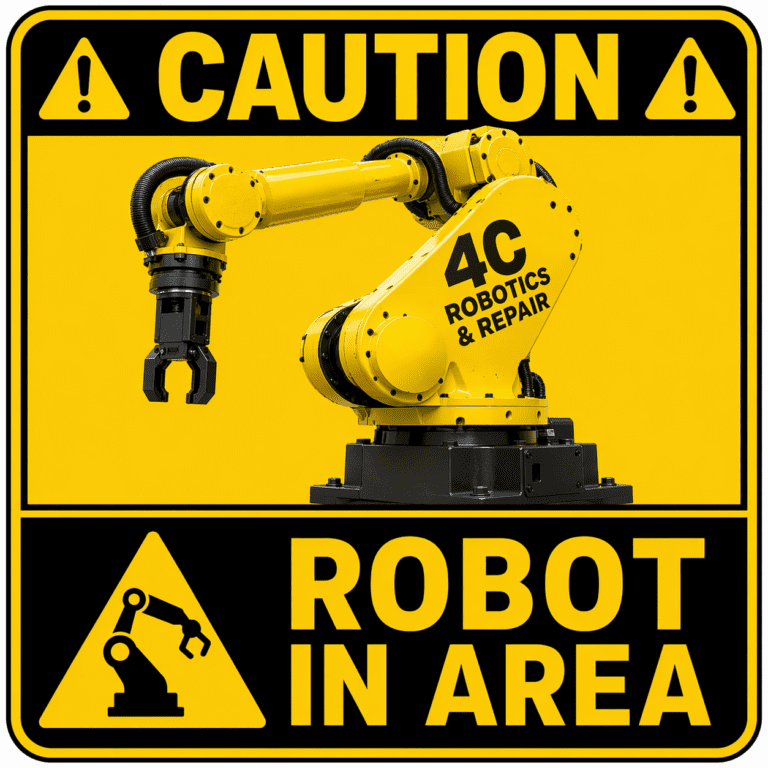
Warning signs, signals, and floor markings help workers stay aware of their surroundings and the robot’s status.
Building a Culture of Safety
The biggest misconception about industrial robots is that they automatically make workplaces safe. In reality, robots are tools—and like any tool, their safety depends on how they are used.
A well-designed robotic system can significantly reduce workplace injuries. But without proper training, maintenance, and safeguards, it can introduce serious risks.
Creating a safe work environment isn’t a one-time effort—it’s an ongoing commitment. As technology continues to evolve, so must our approach to safety.
Final Thoughts
Industrial robots are transforming manufacturing for the better. They improve efficiency, consistency, and—when used correctly—worker safety. But the responsibility doesn’t end with installation.
By prioritizing safety at every stage—from design and training to daily operation—companies can protect their workforce while embracing the benefits of automation.
Because at the end of the day, the goal is simple: every worker goes home safe.
